
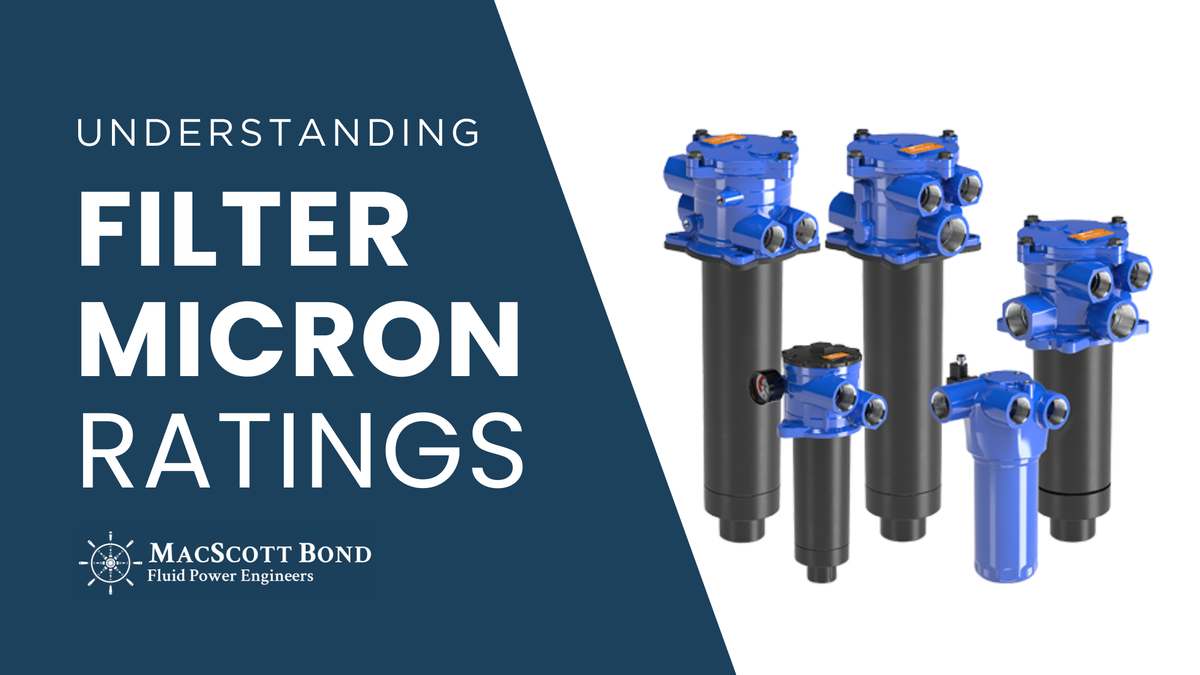
In the world of hydraulic systems, cleanliness is everything. Contamination is the leading cause of hydraulic system failure, with even tiny particles capable of causing significant wear, reduced efficiency, and costly breakdowns.
To combat this contamination risk, most equipment and industrial applications include hydraulic oil filters that are designed to trap solid contaminants and preserve system integrity. One of the key specifications in any hydraulic filter for removing particulate solids is the micron rating, yet many users remain unclear about what this value means and how it affects their equipment.
In this guide, we at MacScott Bond aim to clarify what micron ratings signify, how they relate to the performance of different filter media, and how they align with ISO cleanliness standards. Whether you manage sensitive, high-precision hydraulic systems or rugged industrial machinery, understanding micron ratings is vital for selecting the right filter for optimum protection, system availability, and total cost of ownership.
What Is a Micron Rating?
A micron (μm) is a unit of measurement equal to one-millionth of a metre (0.001 mm). In hydraulic filtration, a micron rating refers to the size of pores in the filter element, which can indicate the size of particles a filter can consistently remove.
For example, a filter with a 10-micron rating is designed to capture particles 10 microns in size and larger.
However, the micron rating alone doesn’t tell the full story. Not all particles have the same size in all directions and may have a long and slender shape; therefore, the probability of a particle being trapped in the element or passing through must be considered.
It's important to distinguish between the two types of ratings:

- Nominal micron rating: Indicates that the filter can trap a certain percentage (typically 50–98%) of particles of a stated size. It offers a general indication of performance but isn’t highly precise.
- Absolute micron rating: More rigorous, indicating the filter will capture 98.7% or more of particles at the rated micron size. This rating is critical for high-precision or sensitive systems.
The choice between nominal and absolute filters depends on your application and the level of protection required. Furthermore, the beta ratio (βx) can be used as an even more robust, test-based metric that quantifies a filter's efficiency. Derived from a standardized multi-pass test (ISO 16889), βx counts the number of particles of size x in the fluid sampled before and after the filter.
Why Particle Size Matters in Hydraulic Systems
Hydraulic systems rely on tight tolerances to function correctly. Particles as small as 5 microns, smaller than a red blood cell, can cause abrasion, clogging, or failure of valves, pumps, and actuators. The majority of component wear is caused by abrasive particles in the 5 - 15 micron range.
To put things into perspective:

- Human hair is roughly 70 microns in diameter
- A grain of talcum powder is about 10 microns
- Fine silt in water is around 2 - 5 microns
Unfortunately, simply fitting the finest possible filter can lead to premature and frequent clogging and incur unnecessarily high initial and replacement costs. It is not about selecting the cheapest or the most expensive filter, but the most cost-effective one.
Choosing a filter with an appropriate micron rating to protect the most sensitive component directly affects system longevity, reliability, and maintenance intervals. This balances filtration efficiency, filter life, and overall plant availability, and the total cost of ownership.
Understanding Filter Media: Glass Fibre vs. Paper Elements
The filter media, the material that traps contaminants, plays a key role in filter performance. Two common types are glass fibre and paper (cellulose) elements:
Glass Fibre Filters
- Made from fine, interwoven glass or other synthetic fibres
- Offer high dirt-holding capacity
- Excellent flow characteristics with minimal pressure drop
- Capable of finer filtration (as low as 3 microns absolute)
- More durable and suitable for high-pressure or sensitive applications
- Costlier than cellulose but longer lasting
Paper (Cellulose) Filters
- Composed of natural fibres
- Less efficient in particle capture, typically for coarser filtration
- Lower cost, but less dirt-holding capacity and shorter service life
- Suitable for less demanding or low-pressure systems
For critical or high-efficiency applications, glass fibre (or a polymer-based fibre layer, such as polypropylene or nylon) is generally the preferred choice, especially when paired with precise absolute micron ratings.
ISO Cleanliness Standards – ISO 4406
The ISO 4406 standard helps quantify hydraulic fluid cleanliness by reporting the number of particles per millilitre at three size thresholds: >4μm, >6μm, and >14μm. These values are reported as codes (e.g., 18/16/13), where each number corresponds to a range of particle counts.
For example:
ISO code 18/16/13 refers to a fluid that contains:
- 18: Between 1,300 and 2,500 particles >4μm
- 16: Between 320 and 640 particles >6μm
- 13: Between 40 and 80 particles >14μm
Lower ISO codes mean cleaner fluid, which correlates with less wear and higher performance. The table below shows the recommended ISO cleanliness for particular hydraulic equipment:
|
Application/Component |
Recommended ISO Cleanliness |
|
High-precision servo valves |
16/14/11 or better |
|
Proportional valves |
17/15/12 |
|
Piston pumps & motors |
18/16/13 |
|
Gear pumps |
19/17/14 |
|
General low-pressure hydraulics |
20/18/15 or higher |
Typical Micron Ratings by Application
Here's a general guide for selecting micron ratings based on application type:
|
Application |
Suggested Micron Rating |
Notes |
|
Mobile machinery (e.g., excavators) |
10 – 25 micron |
Balance between protection and flow |
|
Factory automation (servo control) |
3 – 10 micron absolute |
Requires precise control |
|
Lubrication systems |
10 – 40 micron |
Coarser filters may suffice |
|
High-performance industrial hydraulics |
3 – 6 micron absolute |
Enhanced protection |
|
Return-line filtration |
10 – 25 micron nominal |
Larger particles only |
|
Suction-line filters |
100 – 150 micron |
Protect against pump damage with low restriction |
Choosing the Right Filter with MP Filtri
At MacScott Bond, we supply a full range of MP Filtri hydraulic filters, including suction, return, pressure, and off-line filters. MP Filtri products are renowned for their quality and performance, offering options across a wide spectrum of micron ratings and filter media types.
Whether you need high-efficiency glass fibre filters for servo valves or cost-effective cellulose elements for general return lines, we can help specify the right product for your system. Many MP Filtri elements are also designed to meet or exceed ISO 16889 test standards for filter efficiency and durability.
Precision Filtration Backed by Trusted Expertise
Understanding hydraulic filter micron ratings is essential for protecting your hydraulic equipment and maximising its lifespan. While smaller micron ratings offer better protection, they may come with trade-offs such as higher pressure drops or total cost of ownership. Selecting the appropriate filter requires a balance between system sensitivity, operational conditions, and cleanliness targets.
With decades of expertise in fluid power systems, MacScott Bond is here to guide you in finding the most effective solution. Our team can help assess your system requirements, target ISO cleanliness levels, and identify the right MP Filtri filters from our extensive inventory.
Ready to Protect Your System?
Contact MacScott Bond today to discuss your hydraulic filtration needs or explore our selection of MP Filtri filters online. Let us help you keep your system clean, efficient, and protected.


