
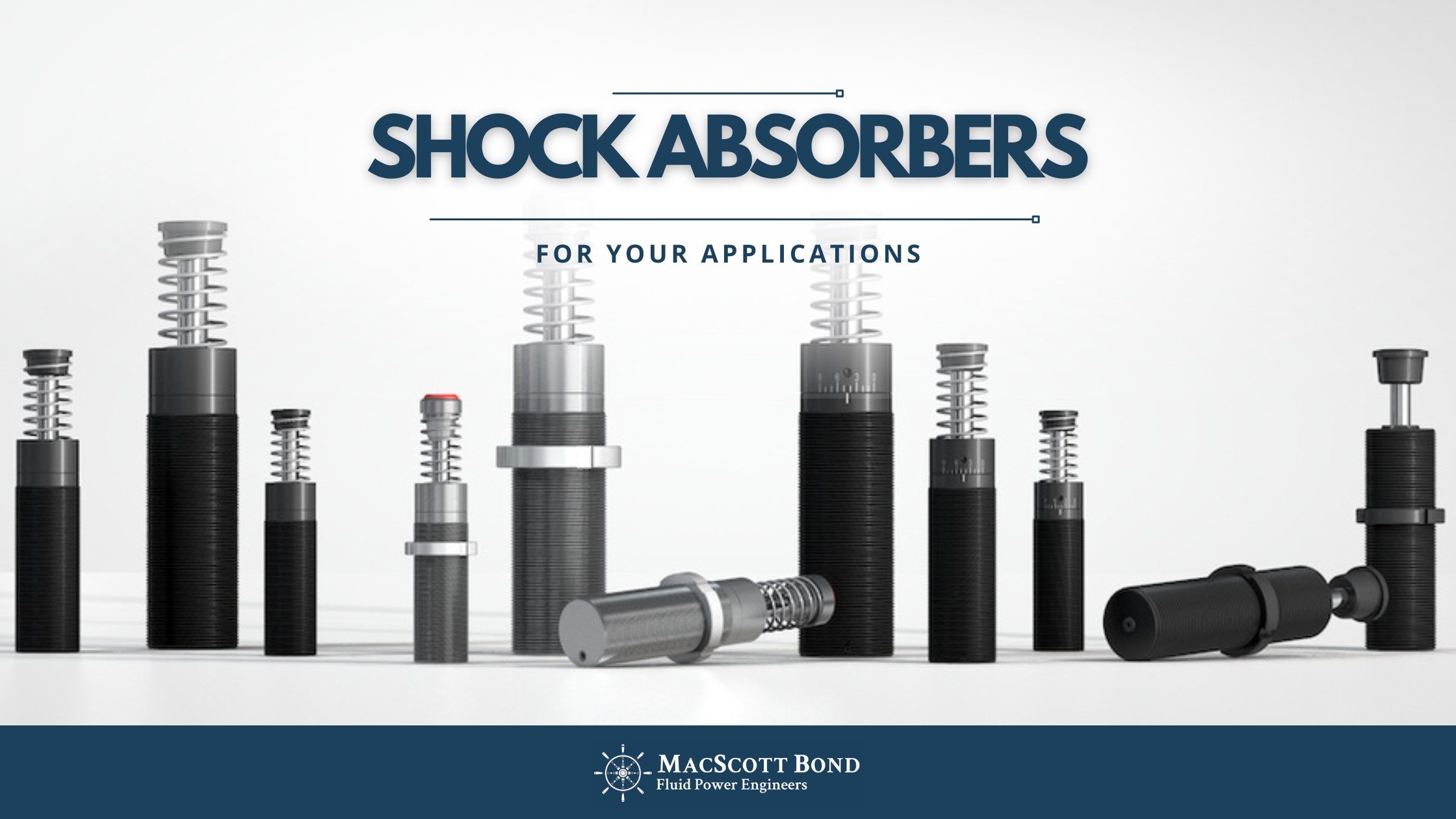
When it comes to industrial applications involving high-speed machinery or moving components, selecting the correct shock absorber is vital for ensuring smooth operation, protecting equipment, and reducing maintenance downtime.
At MacScott Bond, we are proud to supply ACE shock absorbers. Widely respected for their performance, adjustability, and durability across a range of industries.
This guide will walk you through how to select the best shock absorber for your application and highlight the different ACE product lines. It will explain how to size and adjust these components, and outline where these devices deliver the most benefit.
What Is an Industrial Shock Absorber?

Industrial shock absorbers, also referred to as industrial dampers, are devices designed to control kinetic energy. They absorb kinetic energy from moving masses and dissipate it as heat energy, reducing velocity and harmful collision impact forces that could otherwise damage machines or structures. The result is smoother motion, better impact protection, and increased longevity for your equipment.
Why Choose ACE Shock Absorbers?
ACE Controls, a global leader in motion control technology, offers a comprehensive range of industrial shock absorbers that cater to everything from light automation systems to heavy-duty machinery. What sets ACE apart is its focus on customisability, compact form factors, and engineering precision. The advantages of ACE shock absorbers include:
- Enhanced operational safety and reliability
- Extended machine lifespan
- Simplified and cost-effective system design
- Reduced maintenance and operating costs
- Quieter and more energy-efficient machinery
- Lower mechanical stress on components
- Increased overall efficiency and profitability
How to Determine the Correct Size
Choosing the right size and model of shock absorber requires understanding the energy involved in your application. ACE recommends using the following core input variables for a reliable calculation:

1. Moving Mass
The mass of the object impacting the shock absorber (in kg).
2. Velocity
The speed at which the mass is moving before impact (in m/s).
3. Stroke Length
How far the object will travel during deceleration (in m) – important for matching energy capacity and establishing the peak shock absorber force.
4. Cycle Frequency
How often the shock absorber is used per minute, per hour, or per day affects both heat dissipation and longevity.
ACE’s sizing tools, such as those found in their calculation bases, use these variables to compute the required energy capacity (Nm) and select a suitable shock absorber based on model limits. These calculations can seem complex, but MacScott Bond is happy to assist with sizing or offer pre-selected units for common applications.
For instance, the table below shows the type of shock to use based on the application’s moving mass value and impact velocity.
|
Application |
Moving Mass |
Impact Velocity |
Recommended ACE Shock |
|
Small conveyor stop |
10 kg |
1.5 m/s |
SC190 |
|
Robotic arm |
25 kg |
2 m/s |
MA225M |
|
Large gate |
500 kg |
1 m/s |
MC45M |
These are general examples. ACE’s charts allow for a more precise match, especially when you factor in the mounting position and stroke length.
Common Mistakes to Avoid When Selecting a Shock Absorber
Even high-quality shock absorbers like those from ACE won’t perform effectively if misapplied. Here are key mistakes to avoid:
1. Under sizing the Shock Absorber
Selecting a shock absorber with insufficient energy capacity can lead to exceeding the stroke length or bottoming out, increased component wear, overheating, and damage to equipment. Always calculate the required energy absorption in the extremes of operating conditions or consult MacScott Bond for help with sizing.
2. Overlooking Environmental Factors
Standard shocks may fail in corrosive, wet, or high-temperature settings. ACE offers corrosion-resistant and temperature-rated models for more demanding environments such as food processing, marine, and harsh outdoor use.
3. Improper Mounting
Incorrect installation is a major cause of poor performance. Misalignment and insufficient stroke clearance, for example, can severely compromise a shock absorber's function. For optimal operation, loads should always be directed along the central axis, keeping any side loading within maximum permissible limits. If the mounting system cannot guarantee this, it's necessary to use side load adapters to correct the issue.
Avoiding these common issues ensures longer-lasting equipment, better energy absorption, and lower maintenance costs. Adjustable shocks should always be fine-tuned during setup to ensure smooth deceleration within the operating length without rebound.
Adjustable vs. Self-Compensating Shock Absorbers

There are two main types of shock absorbers that ACE Controls offers:
1. Self-Compensating Models
These are pre-set by the manufacturer and automatically adjust to changes in energy levels within a defined range. They are ideal for consistent, repeatable motions and are maintenance-free. Self-compensating shock absorbers are best for automated machinery, mass production lines, packaging equipment, and load sharing in general (where two or more shock absorbers are required to decelerate a single mass).
2. Adjustable Models
These are perfect for applications that require flexibility. With a simple adjustment mechanism, typically located at the end of the unit, you can precisely control the deceleration profile for alternative weights or speeds. This makes them ideal for prototypes, testing environments, or any application with changing operational variables and custom automation.
Adjustment Procedure (ACE Adjustable Shocks)
Adjusting ACE shock absorbers is straightforward:
- Start with the lowest damping setting.
- Mount the shock absorber in your application.
- Run a test stroke and observe the deceleration. A good setup will bring the moving mass to a smooth stop without bouncing or hitting the end of the stroke too early.
- Increase damping incrementally until optimal performance is achieved.
- Lock the adjustment screw if applicable.
Always refer to ACE’s installation instructions or contact MacScott Bond for tailored guidance.
Material and Environmental Considerations
ACE provides models with different materials and sealing technologies for diverse environments. Depending on your operating conditions, consider the following:
- Corrosion-resistant shock absorbers (e.g., stainless steel models) are ideal for marine, food processing, and chemical industries
- High-temperature models can operate in conditions up to +150 °C, useful in foundries or drying systems
- Low-temperature variants perform reliably down to -40 °C, commonly needed in refrigerated automation
If your system experiences vibration, ACE also offers models with integrated vibration-damping features for dual-purpose protection.
Industries that Benefit from ACE Shock Absorbers
Shock absorbers are used wherever energy needs to be controlled, but some sectors realise the greatest gains:

- Automation and Robotics: Stopping high-speed pick-and-place arms or conveyor systems cleanly and quietly enhances precision and prevents jarring rebounds.
- Material Handling: Dock equipment, cranes, and shuttles require reliable deceleration to prevent damage and injury.
- Manufacturing: From press machines to tool changers, shock absorbers ensure predictable operation and reduce factory noise.
- Food & Beverage/Pharmaceutical: Corrosion-resistant shocks help ensure hygiene compliance and operational safety.
- Prototyping and R&D: Adjustable units are invaluable when experimenting with different weights, speeds, or cycles.
Support from MacScott Bond
At MacScott Bond, we don’t just supply parts; we support your entire process, from selecting and sizing the correct shock absorber to installation and ongoing advice.
Our team can help with:
- Shock absorber sizing and specification
- Providing custom configurations
- Stocking standard models for regular users
- Fast supply of ACE accessories, e.g., mounting plates, stop collars, and replacement units
We’re also happy to offer CAD files or product data sheets upon request for design engineers.
Expert Help with Shock Absorber Selection
Whether you're looking to upgrade your automation line, protect an investment in heavy machinery, or simply improve the load capacity handling of your system, ACE shock absorbers deliver reliability and performance.
While the selection process can be technical, tools like ACE’s online guides and the team at MacScott Bond make it straightforward. With a wide variety of temperature range performance, corrosion-resistant options, and both adjustable and self-compensating models, there’s a solution for every environment.
If you’re unsure which shock absorber is best for your setup, don’t hesitate to contact MacScott Bond. We’ll help you find the perfect fit and help keep your operations running smoothly.


