
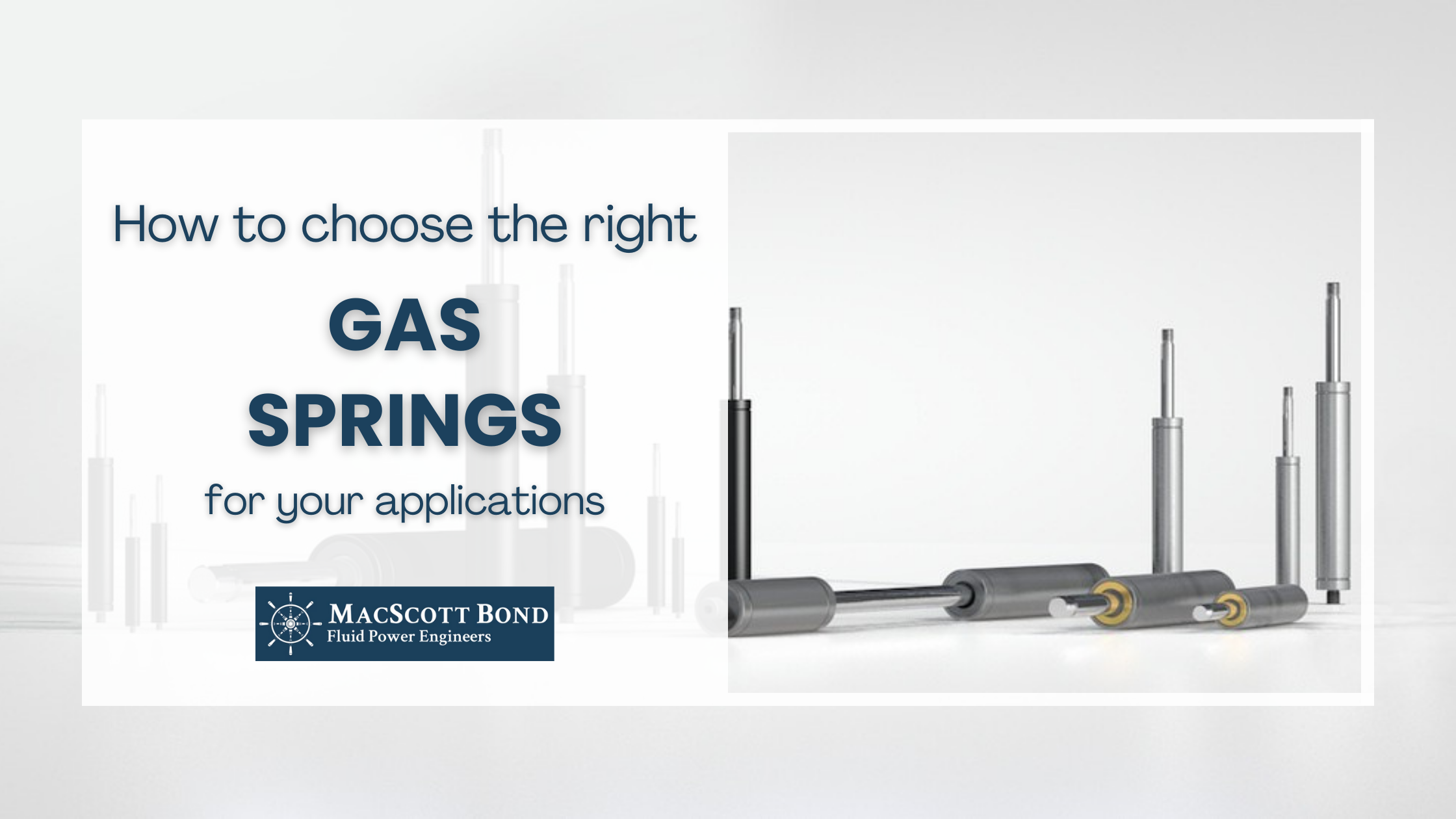
Gas springs, also known as gas struts, are essential components in a wide variety of applications, from lifting and supporting hatches, lids, and panels to enabling smooth motion control in machinery and vehicles. Selecting the correct gas spring requires a careful assessment of load, geometry, and motion dynamics.
In this guide, we’ll explain how gas springs work, how to calculate the correct specifications based on your application’s centre of gravity, and when to seek expert help from MacScott Bond.
How Gas Springs Work

Push Type gas springs are self-contained, sealed cylinders filled with compressed nitrogen gas and oil. A piston rod extends from the cylinder to constantly apply an extension force pushing outwards. The pressurised nitrogen gas provides this extension force, while the oil offers damping to control the speed and lubricate the piston and seals. The force they provide helps lift heavy objects safely and easily, even holding them in place once raised. Gas springs are commonly used in:
- Vehicle bonnets and tailgates
- Industrial access panels
- Furniture lids and flaps
- Agricultural and construction machinery
Steps to Choosing the Right Gas Spring

Choosing the correct gas spring begins with understanding your application’s centre of gravity. This is the support point where the weight of your lid or panel is evenly balanced. When the gas spring is open or closed, both the weight distribution and the force required vary based on the pivot point and angle.
Here are the basic steps to choose the right gas spring:
-
Determine the weight and dimensions of the lid: Measure the full weight of the panel or lid that the gas spring will assist. Also, note its dimensions and pivot (hinge) point.
-
Calculate the centre of gravity: The centre of gravity is typically located at the midpoint of the panel’s length (assuming uniform weight). However, for irregular shapes or materials, more complex calculations are required.
-
Estimate mounting points and opening angle: Identify where the gas spring will be mounted and the desired maximum opening angle. These positions determine the extended and retracted lengths for the gas spring and significantly affect the spring’s required force.
- Calculate Required Force: Using the centre of gravity, mounting distances, and opening angle, you can estimate the force the gas spring must exert to counterbalance the weight of the assembly and lift the load.
Minor changes in mounting points or angles can drastically change the required force, and incorrect specifications can result in safety hazards, poor performance, or damage to components. To simplify this process, helpful online tools are available, such as the ACE Controls Selection Tool.
For a visual walkthrough, this video also demonstrates the principles.
Need Help? MacScott Bond Has You Covered
While these tools can provide rough estimates, precise selection often requires more advanced calculations. At MacScott Bond, we offer full support for selecting and sourcing the correct gas spring for your application. Simply provide us with:
- Lid/panel weight and dimensions
- Mounting locations or photos
- Desired opening angle
- Usage frequency and environment
- Environmental conditions (outdoors, marine, etc.)
- The number of struts to be used (commonly two)
With this information, our team can carry out centre of gravity calculations and recommend the optimal spring. We can also supply a wide range of custom and standard gas springs, as well as assist with mounting hardware and recommended replacement parts.
Expert Help for Gas Spring Selection
Selecting the right gas spring involves understanding weight distribution, centre of gravity, and geometry to ensure reliable and safe operation. While online calculators are a great starting point, MacScott Bond can offer expert advice and precise recommendations tailored to your specific application. Get in touch with our team today and take the guesswork out of gas spring selection.


